

Commercial Grill and Griddle Repair
COMMERCIAL GRILL AND GRIDDLE REPAIR IN La Puente, CA.
A thermostatic commercial griddle regulates each 12-inch section on its own, from roughly 200 degrees at the low setting to 550 at the high, which is why a cold band across one zone almost never means the whole appliance failed on you. Elite Flame Appliance Repair LLC handles commercial grill and griddle repair in La Puente, CA on flat tops, charbroilers, and chargrills: zone thermostats, burner ports, manifold pressure, plate leveling, and the ignition components behind all of it.
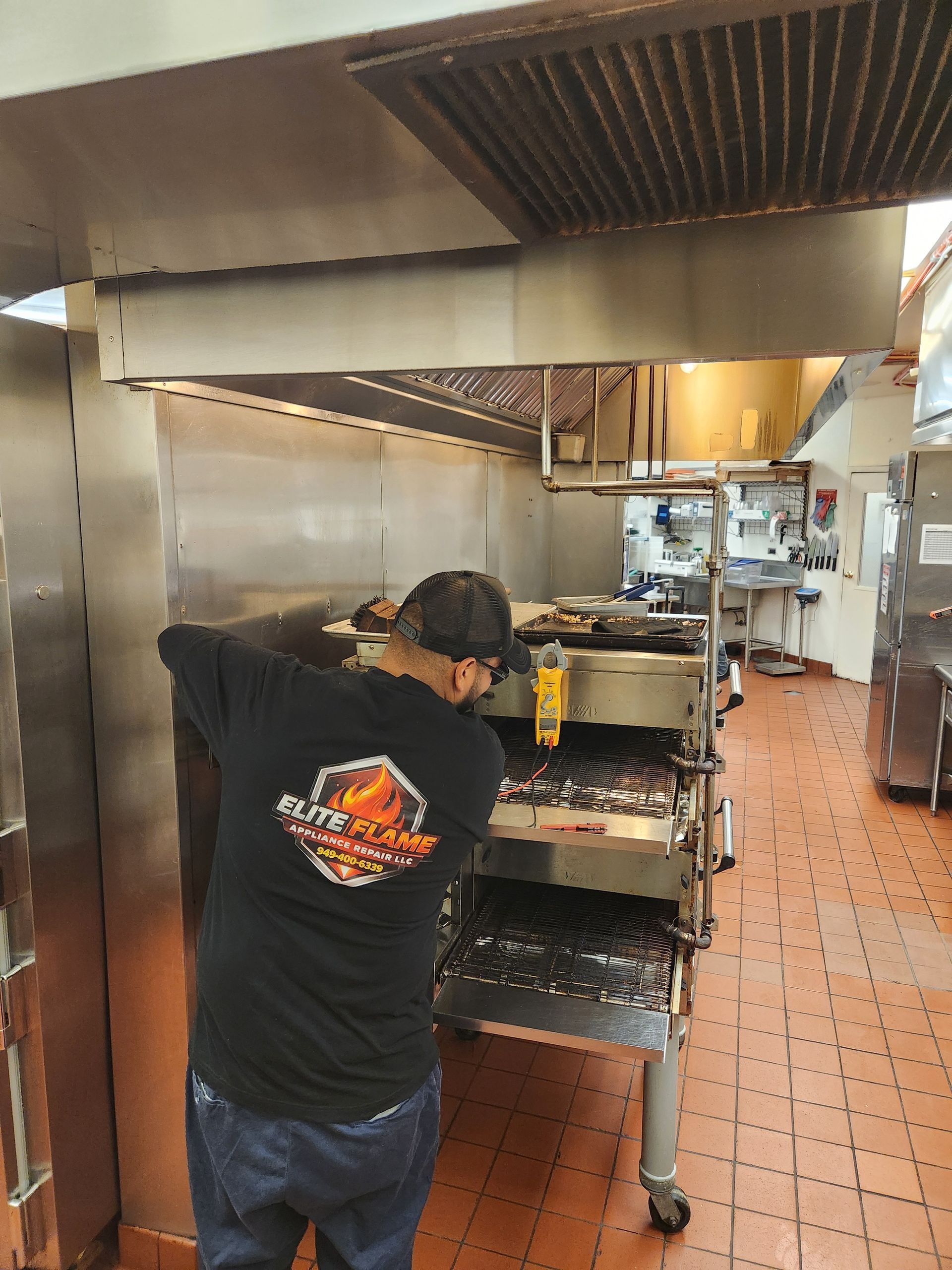

A FLAT TOP IS SIX APPLIANCES PRETENDING TO BE ONE.
Each thermostatically controlled section has its own bulb, its own valve, and its own burner underneath. That is why the eggs cook fine on the left and the pancakes will not color on the right. Treating the plate as one unit leads to a full thermostat replacement when a single zone was the problem.
So the plate gets mapped. Surface temperature is read across every section at the same setpoint, and only the zones that fail that comparison get taken apart and worked on.
- Surface temperature mapped zone by zone
- Burner ports cleaned rather than burned clear
- Plate level checked against the frame
- Manifold pressure compared to the rating plate
COMMERCIAL GRILL AND GRIDDLE REPAIR
LOW FLAMES ARE A PRESSURE PROBLEM UNTIL PROVEN OTHERWISE.
When a grill will not climb past 400 degrees, the instinct is to blame the appliance. The measurement usually says otherwise. Manifold pressure with a single burner firing has to sit within about three tenths of an inch of water column of the rating plate value, and a whole line sharing an undersized supply will drop below that every time the fryers call for heat at once.
GRILLS RUN HARDEST IN LA PUENTE.
Carne asada, burgers, and breakfast plates keep flat tops and charbroilers loaded from morning through close across this part of the San Gabriel Valley. California requires 4 feet of vertical clearance between a charbroiler and the grease removal device above it, and a hood pulling at less than 500 feet per minute puts smoke on your line instead of outside where it belongs.
FLAT TOPS TELL US WHERE THEY HURT.
Put a hand over a griddle plate and the failure announces itself. A cold strip down the middle is a burner. A cold third at one end is a thermostat. A plate that browns fine but takes forever to recover is a pressure or a burner port problem. Reading the surface before pulling a panel has saved more parts than any diagnostic tool we own. What is your plate doing?
WHY CHOOSE US FOR COMMERCIAL GRILL AND GRIDDLE REPAIR.
One Zone Fixed, Not Six Replaced
Mapping the plate before opening it means you pay for the section that actually failed. A full thermostat set on a griddle is an expensive way to solve a single dead zone.
Even Heat Across The Whole Plate
Consistent surface temperature means your line stops working around a cold corner. Cook times settle, plates match each other, and the station stops needing a workaround everybody has quietly memorized.
Ports Cleaned Without Damage
Burner ports get cleared mechanically, not opened up with a drill or burned out. That difference is why a cleaned burner still fires evenly 2 years later instead of running ragged.
Grease Handling Checked Too
Filters at the wrong angle, an overfilled drip container, or a duct running below required velocity all show up as a grill problem. We look above the appliance as well as inside it.
Warped Plates Diagnosed Honestly
A plate that has warped past a certain point cannot be leveled back into service. You will hear that plainly rather than paying for adjustments that will not hold through the next week.
Service Set Around Your Rush
Grills cannot be worked on hot, and they take a long time to cool. Scheduling before open or after close is what makes a same-day repair realistic instead of theoretical.
WHAT WE FIX
OUR GRILL AND GRIDDLE WORK
Flat tops, charbroilers, and chargrills share a gas system and almost nothing else. Below is a list of what fails on each of them and what gets tested before anything at all is taken apart.
ZONE HEAT
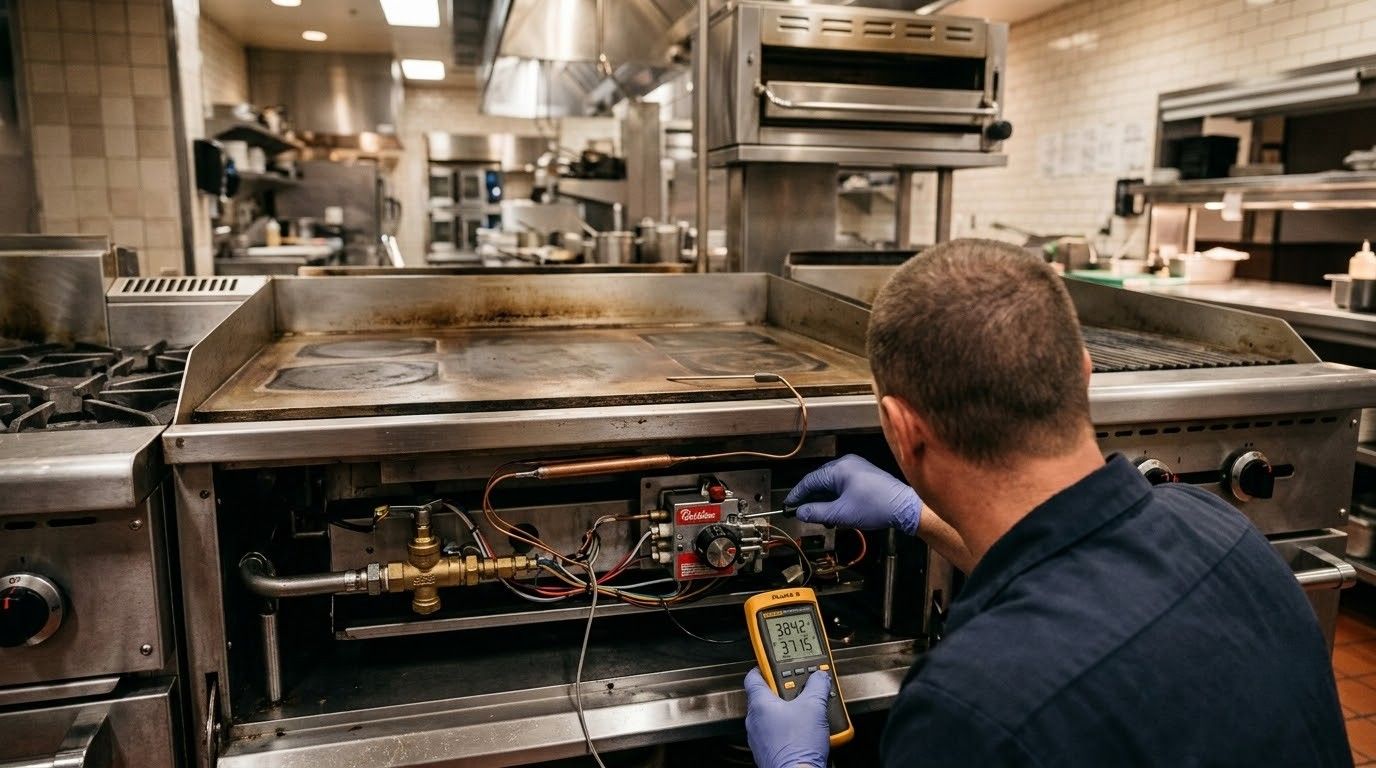
Griddle Thermostat and Zone Repair
Snap-action thermostats, capillary bulbs clamped under the plate, and control valves. A zone reading 80 degrees below its neighbors at the same setting is almost always a bulb that has lost charge.
BURNERS
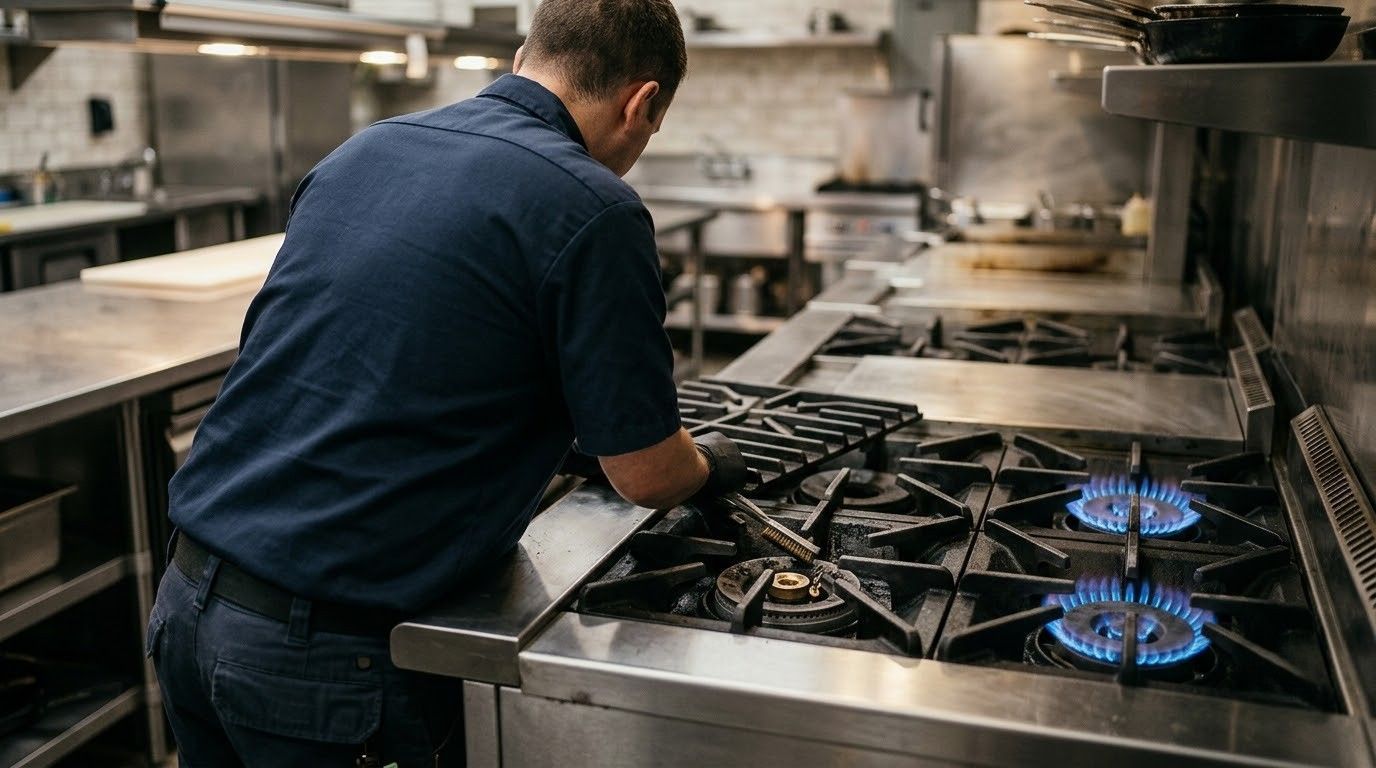
Burner, Port, and Orifice Service
Clogged ports, cracked burner castings, and orifices sized for the wrong gas after a conversion. Flame pattern is inspected across the full burner length, since a lazy yellow tip means incomplete combustion.
CHARBROILERS
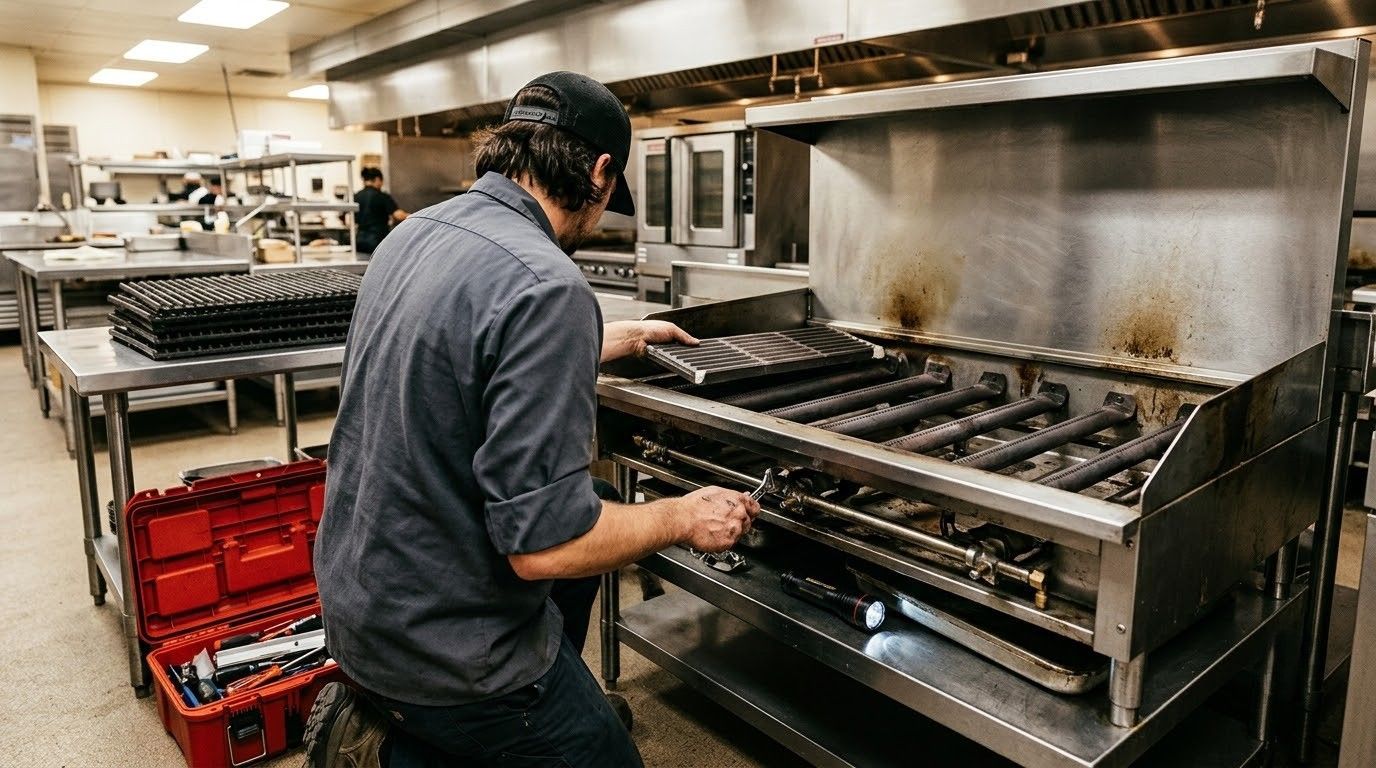
Charbroiler and Radiant Repair
Cracked radiants, burnt-through grates, warped supports, and valves that no longer modulate. Radiants that have failed produce hot spots and flare-ups long before anybody thinks to look under the grates.
GAS SUPPLY
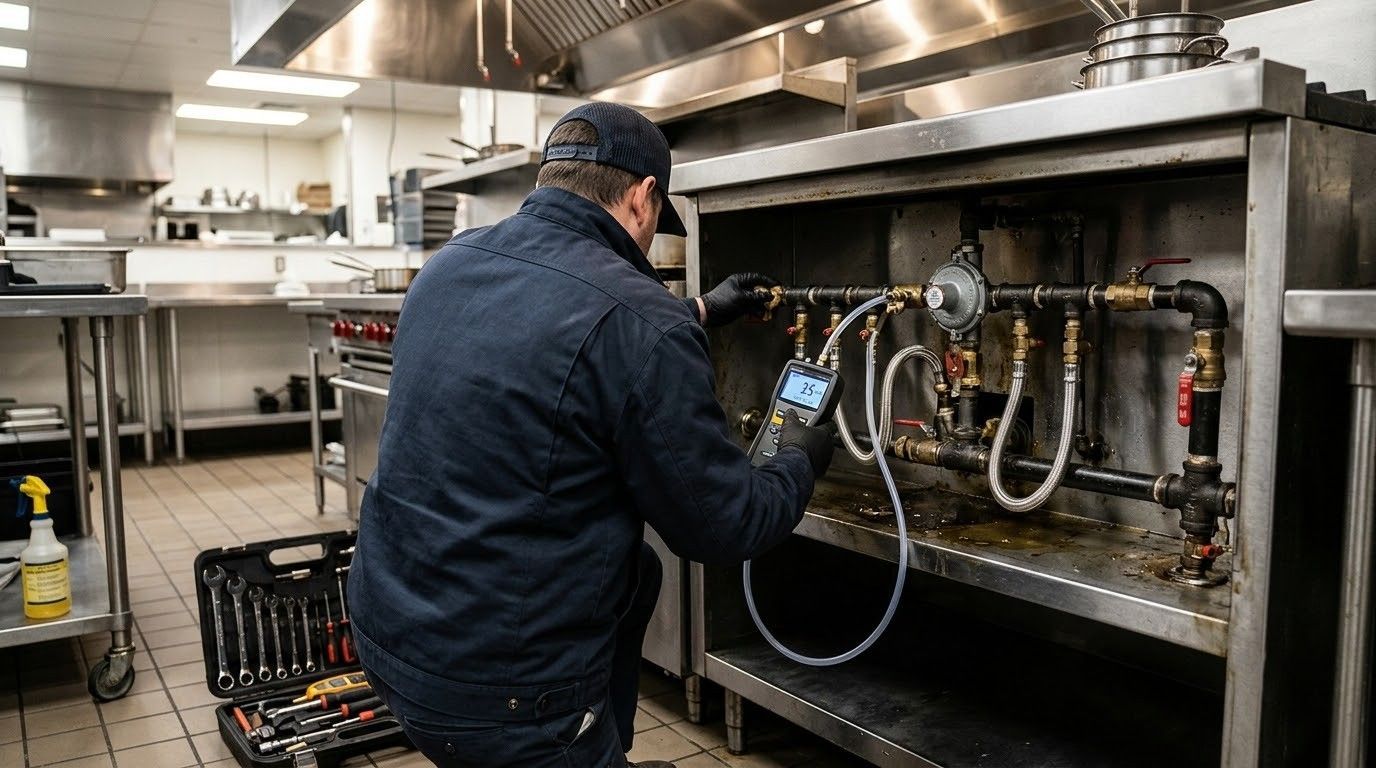
Manifold Pressure and Regulator Service
Regulators drifting out of adjustment, undersized supply lines, and pressure that collapses when the rest of the line fires. This is measured with a manometer, because nobody can see gas pressure.
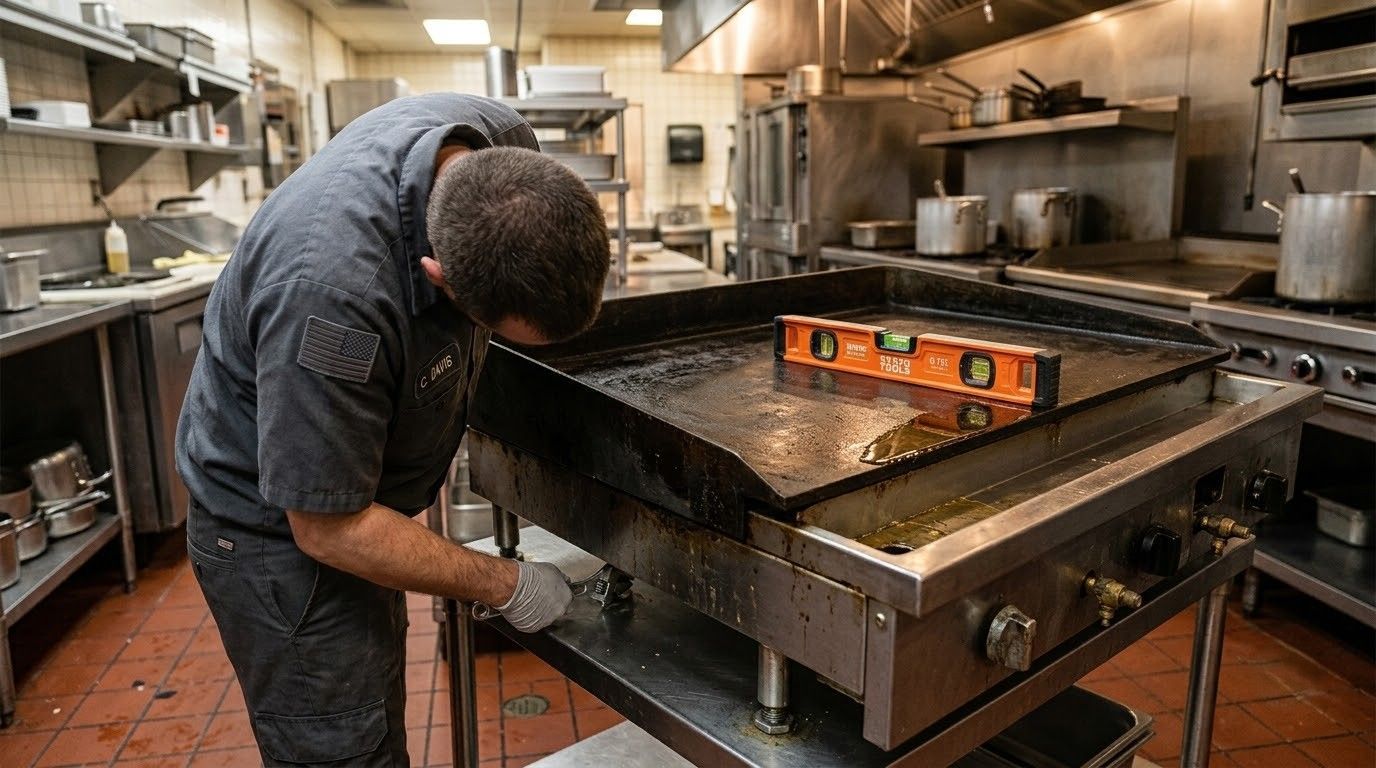
PLATE WORK
Griddle Plate Leveling and Seasoning
Frames that have shifted, feet out of adjustment, and plates that no longer drain toward the trough. Level is set against the frame, then confirmed with liquid rather than by eye.
IGNITION
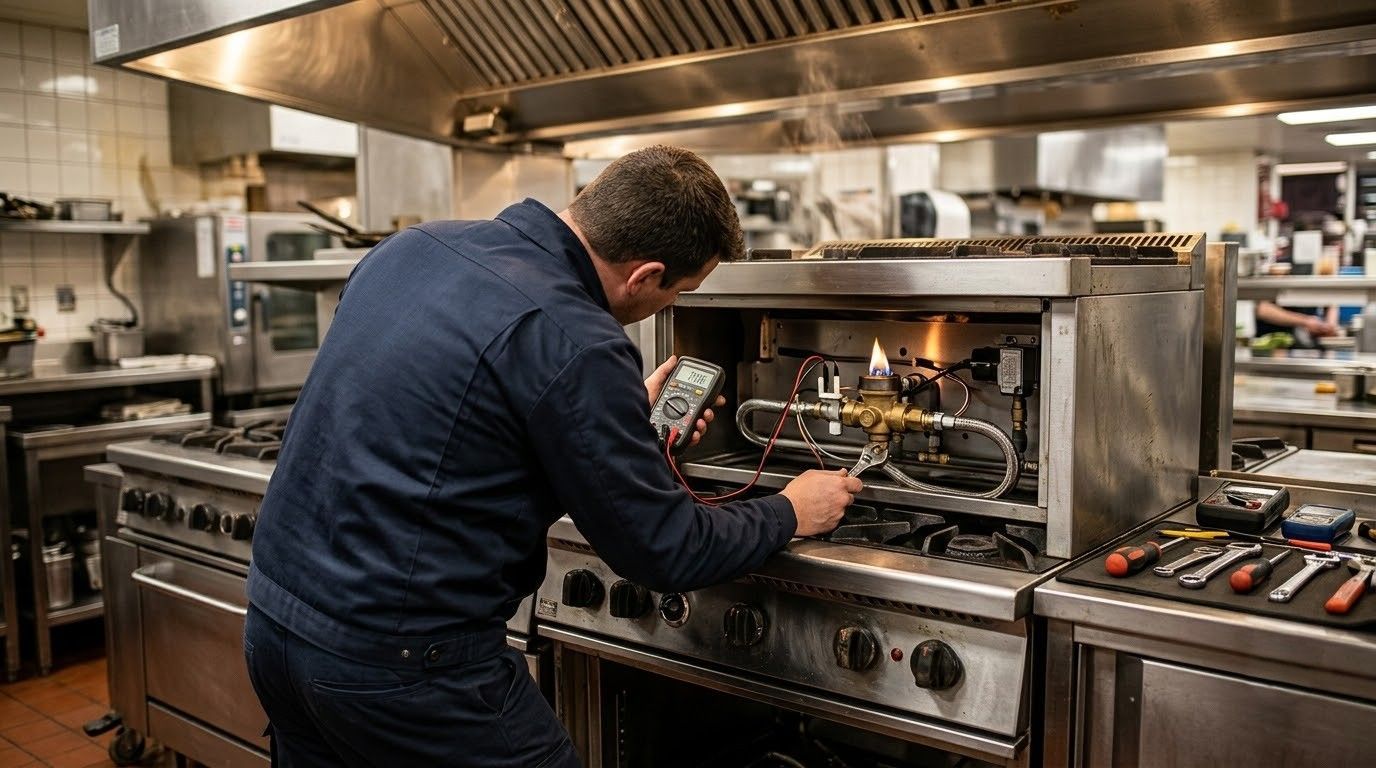
Pilots, Igniters, and Safety Valves
Standing pilots that blow out under hood draft, spark igniters, thermocouples, and safety valves. Draft is checked as part of the diagnosis, since a pilot in the wrong airstream will never stay reliable.
faq
frequently asked
questions.
The grill and griddle questions we get asked most often, usually about heat that will not climb, flames that look wrong, or a plate that has stopped cooking evenly.
Why is my griddle not getting hot?
Start with gas supply pressure, then the zone thermostat, then the burner itself. If only part of the plate is cold, the supply is fine and the fault sits in that section's control or burner.
Why will my grill not get hotter than 400 degrees?
Low manifold pressure is the most common cause, followed by partially blocked burner ports. Both restrict the amount of gas actually burning, and both are invisible without a manometer and a close look at the flame.
Why is my gas grill flame uneven?
Blocked ports, a cracked burner casting, or debris in the venturi. An uneven flame with yellow tips also suggests the air shutter has drifted, which changes combustion and leaves soot on the underside.
How do you clean clogged burner ports properly?
Mechanically, with a port cleaner sized to the opening, then verified by watching the flame across the whole burner. Elite Flame Appliance Repair LLC does this on grill calls throughout La Puente, CA.
How do I season a commercial griddle?
Clean the plate to bare metal, heat it to roughly 350 degrees, apply a very thin layer of high-smoke-point oil, and let it polymerize. Repeat in thin coats rather than one thick one.
Why is my thermostat not reaching the set temperature?
Either the bulb is no longer sensing correctly, the valve is not opening fully, or the burner cannot deliver the output the setting demands. Comparing that zone against its neighbors separates the three quickly.
Can a warped griddle plate be repaired?
Minor warping can sometimes be improved by resetting the frame and level. Severe warping cannot. Elite Flame Appliance Repair LLC assesses that honestly for kitchens across La Puente, CA before any work is scheduled.
Why does grease keep collecting on my line instead of venting?
Usually the exhaust is moving too slowly. Grease ducts have to maintain at least 500 feet per minute, and filters must sit at 45 degrees or steeper to shed what they catch back into the trough.
HOW WE WORK
FROM A COLD CORNER TO AN EVEN PLATE.
STEP 01
Map The Problem Over The Phone
Tell us which part of the plate is cold and whether it is one section or the whole surface. That single detail decides whether we are chasing a thermostat or a gas supply problem.
STEP 02
Book It Cold
Grills need hours to cool before anyone can safely work on them. Visits are set early or late so the plate is at room temperature when we arrive instead of 2 hours after.
STEP 03
Read The Surface
Every zone is brought to the same setpoint and measured. The resulting map shows which sections are in spec and which are not, before a single fastener on the appliance has been touched.
STEP 04
Check What Feeds It
A manometer goes on the gas line and readings are taken with one burner firing and with the whole line firing. Pressure that collapses under load is a completely different problem to solve.
STEP 05
Repair And Re-Map
Ports are cleaned, thermostats are replaced, level is reset, and then the surface is measured again at the same setpoint. Matching zones on that second map is the only real proof that matters.
STEP 06
Flag What Is Coming
Radiants going brittle, a frame beginning to twist, or a hood not pulling what it should all get written down, so the next failure arrives on your schedule instead of during a Friday service.
REQUEST YOUR SERVICE CALL
GET EVERY ZONE BACK IN SPEC.
A grill that only works on one end is costing you speed on every ticket. Send the make, the model, and which section is cold through the contact form or the booking page, and the plate gets mapped before anything comes apart.
WHAT YOUR SERVICE CALL COVERS:
- Surface temperature mapped across every zone
- Manifold pressure read under single and full load
- Burner ports and flame pattern inspected
- Plate level checked and reset where possible
- Ignition and safety valve function verified
- Written map and findings left with you