

Commercial Oven and Range Repair
COMMERCIAL OVEN AND RANGE REPAIR IN La Puente, CA.
A gas restaurant range regulates from roughly 250 degrees at the low stop to 500 at the high, and manufacturers state that accuracy is best between 300 and 500, which is why drift shows up at low bake settings first. Elite Flame Appliance Repair LLC provides commercial oven and range repair in La Puente, CA, covering deck, convection, and combi ovens, open burners, and oven thermostats calibrated against a probe rather than a dial marking. Manifold pressure is verified on every call.
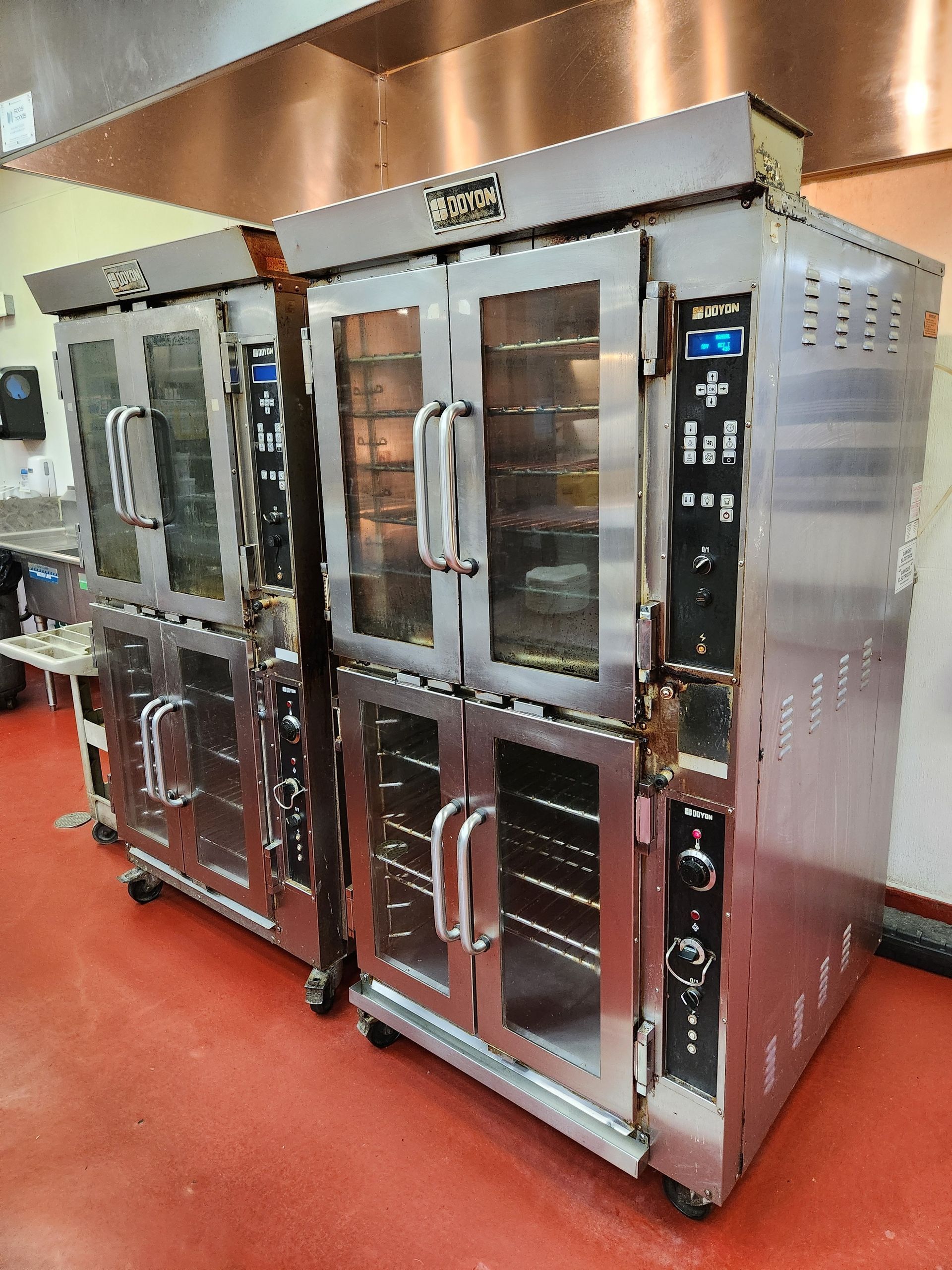

AN OVEN THAT LIES TO YOU IS WORSE THAN ONE THAT DIES.
A dead oven gets fixed on Monday. An oven reading 350 while it holds 385 ruins product for a month before anyone works out why. Calibration drift is the most expensive fault in a bakery or a restaurant because it hides inside food cost, not inside a repair invoice, and it worsens gradually rather than all at once.
So we measure. A probe goes in the cavity, the unit is cycled to a stable setpoint, and the offset is corrected at the thermostat until the reading and the dial finally agree.
- Cavity temperature verified with a test probe
- Manifold pressure read at the appliance
- Door gaskets and hinges checked for seal
- Convection motors and blower wheels inspected
COMMERCIAL OVEN AND RANGE REPAIR
UNEVEN BAKES ARE A SYMPTOM, NOT A SETTING.
Product browning on one side, trays that need rotating halfway, or a deck that runs hot at the back all point somewhere specific. It could be a convection motor slowing under load, a warped door letting heat escape at the hinge, a blocked flue, or a thermostat bulb that has lost its charge. Guessing between those four costs parts. Measuring between them costs roughly an hour of labor.
THE SAN GABRIEL VALLEY BAKES EARLY.
La Puente has a long bakery tradition along its downtown corridor, and panaderias keep ovens running from well before dawn. That schedule leaves almost no window for repairs and almost no tolerance for a deck that is off by 25 degrees. We work around those hours instead of asking a bakery to lose a morning, because a missed morning is a missed week of customers.
A THERMOSTAT DIAL IS AN OPINION. A PROBE IS A FACT.
Most of what we correct on ovens comes down to that difference. Dial markings wear, bulbs lose charge, and capillary tubes get kinked behind the panel during a previous repair. The habit of putting an instrument in the cavity on every single call, rather than trusting the number stamped on the front, is what separates a repair that lasts from one that gets called back. How far off is yours?
WHY CHOOSE US FOR COMMERCIAL OVEN AND RANGE REPAIR.
Product That Comes Out The Same Every Time
Consistent cavity temperature is the difference between a recipe and a gamble. Calibrated equipment means your cook times stop moving and your food cost stops absorbing the difference quietly.
Gas Faults Traced, Not Guessed
Spark without ignition has four or five possible causes, and each one has a test. Working through them in sequence costs less than replacing an ignition module that was never the problem.
Doors That Actually Seal Again
A failed gasket bleeds heat, scorches the cabinet front, and forces the burner to run longer for the same result. Replacing it restores both the temperature curve and the energy bill.
Convection That Moves Air Evenly
Blower wheels load with grease and motors slow before they stop. Cleaning and rebalancing the fan usually fixes uneven browning without touching the thermostat at all.
Early Mornings And Late Nights Covered
Bakeries and restaurants do not share a schedule, so neither do we. 7-day availability means the repair happens in your dark hours instead of your busiest ones.
Documented Readings You Can Keep
Before and after temperature readings, manifold pressure, and the parts replaced all get written down. That record is useful for warranty claims and for tracking which unit is quietly failing.
WHAT WE REPAIR
OUR OVEN AND RANGE WORK
Six areas cover nearly every oven and range call we take. Each one has its own tests, and the order they are run in is what keeps the visit short and the parts list honest.
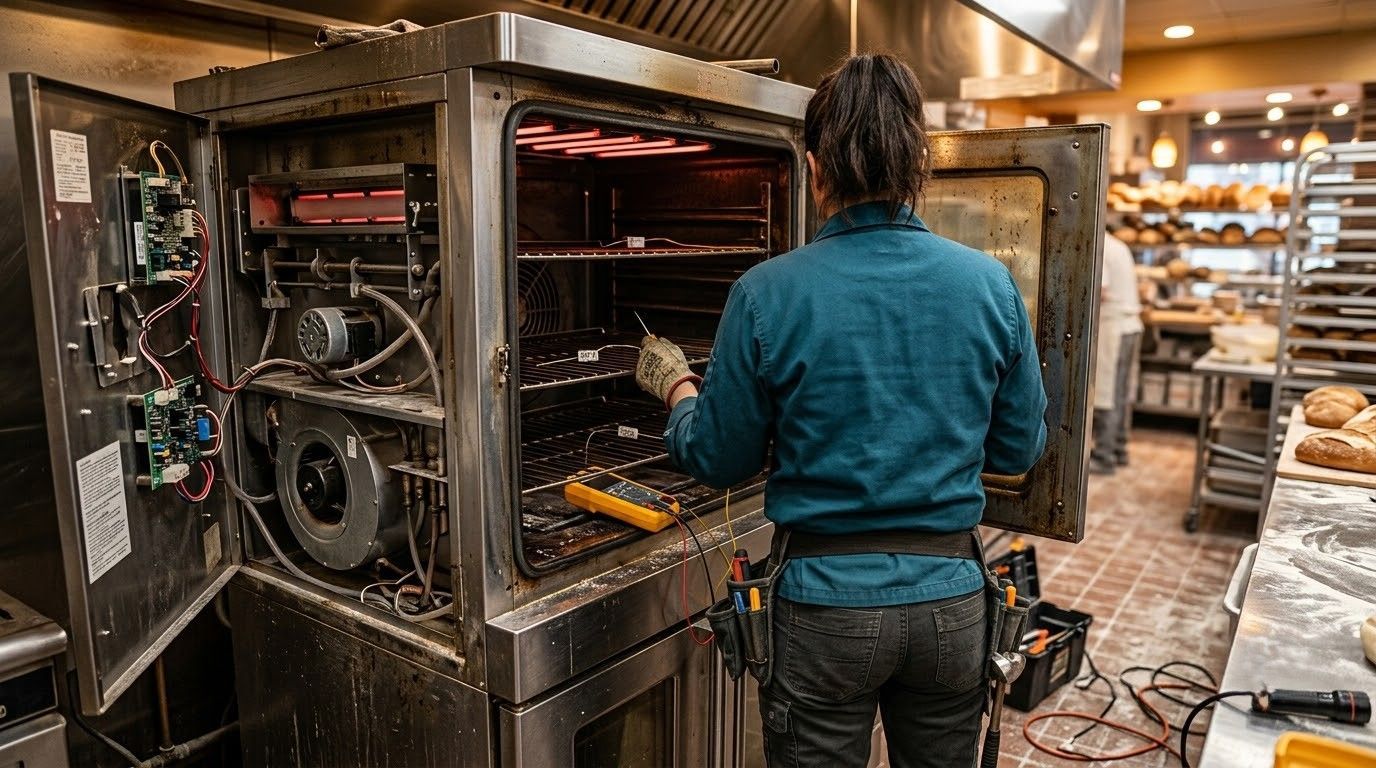
BAKE DECKS
Deck and Convection Oven Repair
Element and burner faults, blower motors, damper linkages, and blocked flues. Cavity temperature is mapped at more than one point, because a single reading in the middle tells you nothing about the corners.
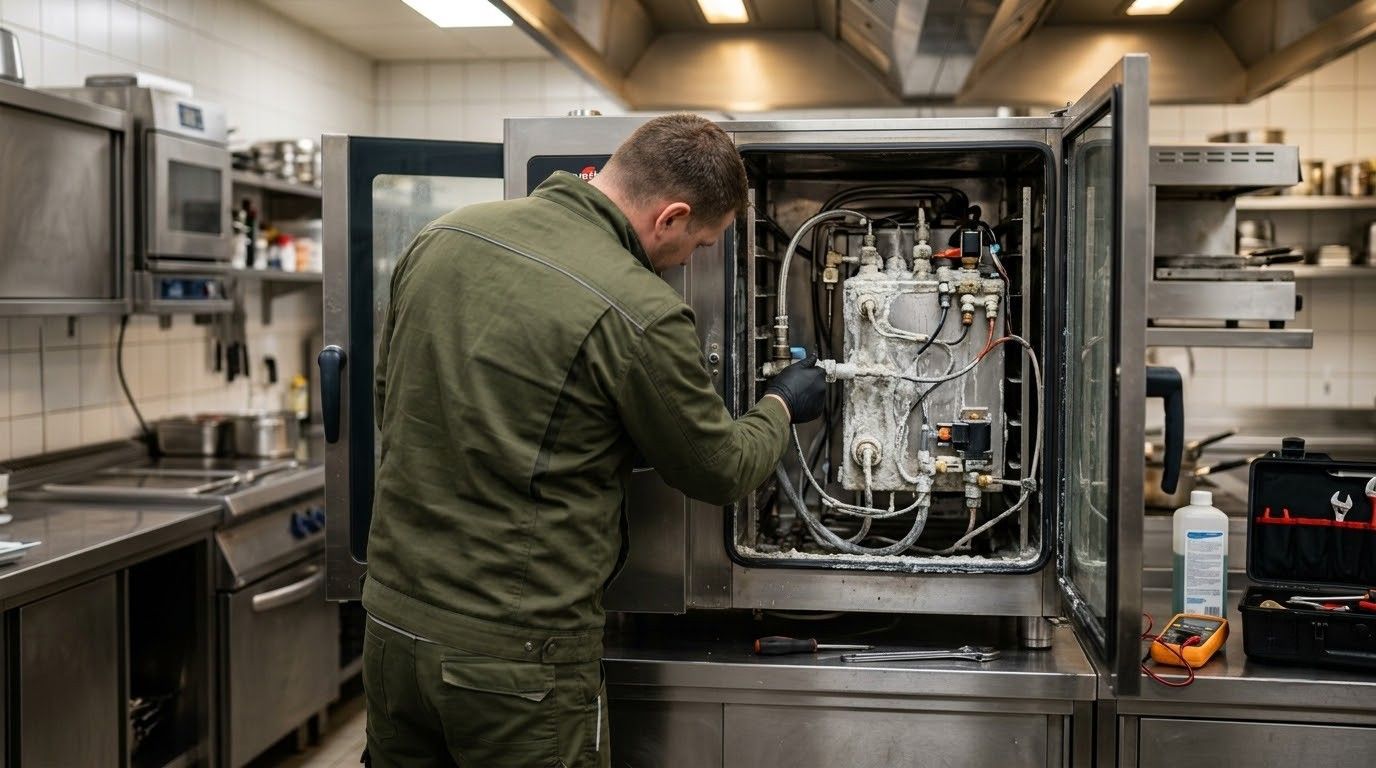
COMBI UNITS
Combi Oven Service
Steam generators, water inlet valves, drain solenoids, and probes. Scale is the usual culprit on local units, since hard water builds inside the boiler faster here than the service manual assumes.
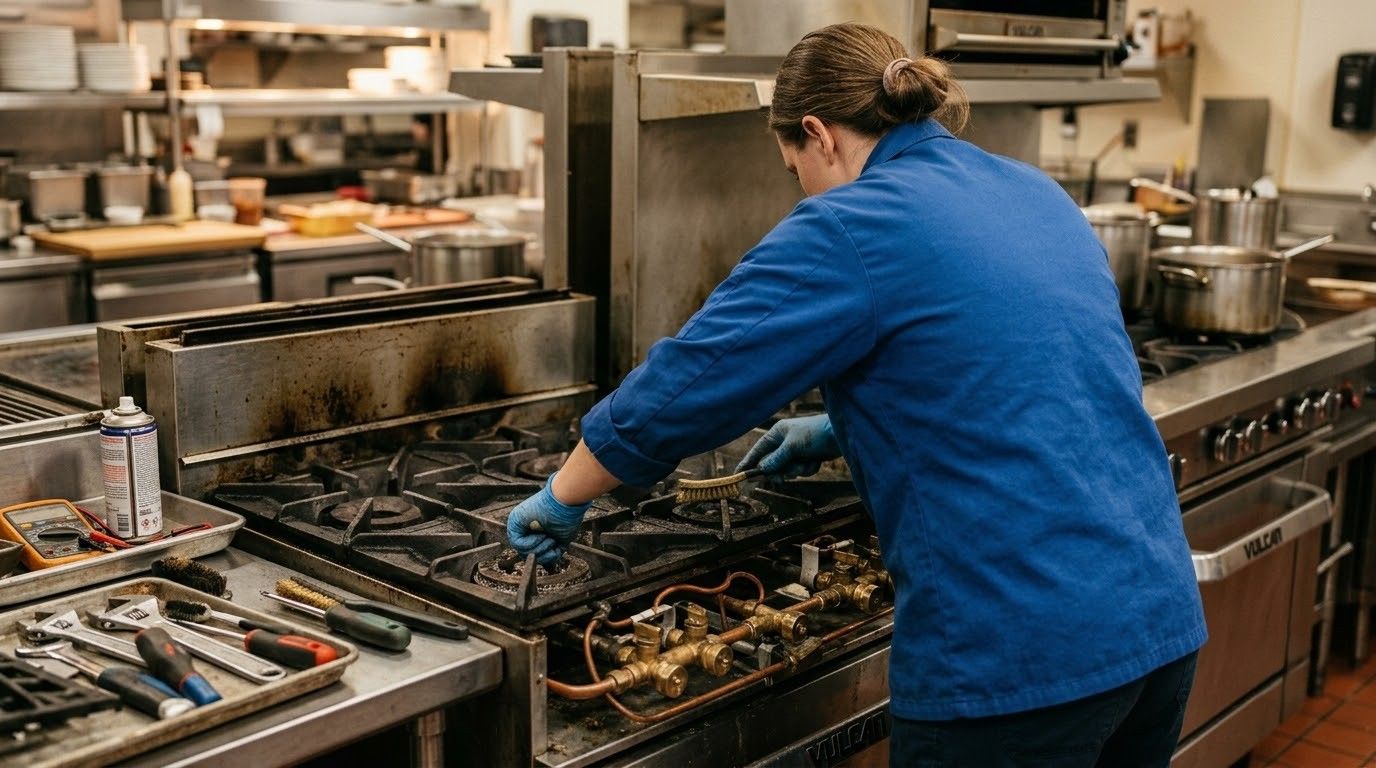
OPEN BURNERS
Range Top and Burner Repair
Clogged ports, cracked burner heads, worn valve stems, and pilots that will not hold. Ports are cleaned mechanically rather than burned out, which is how a burner survives the cleaning it needed.
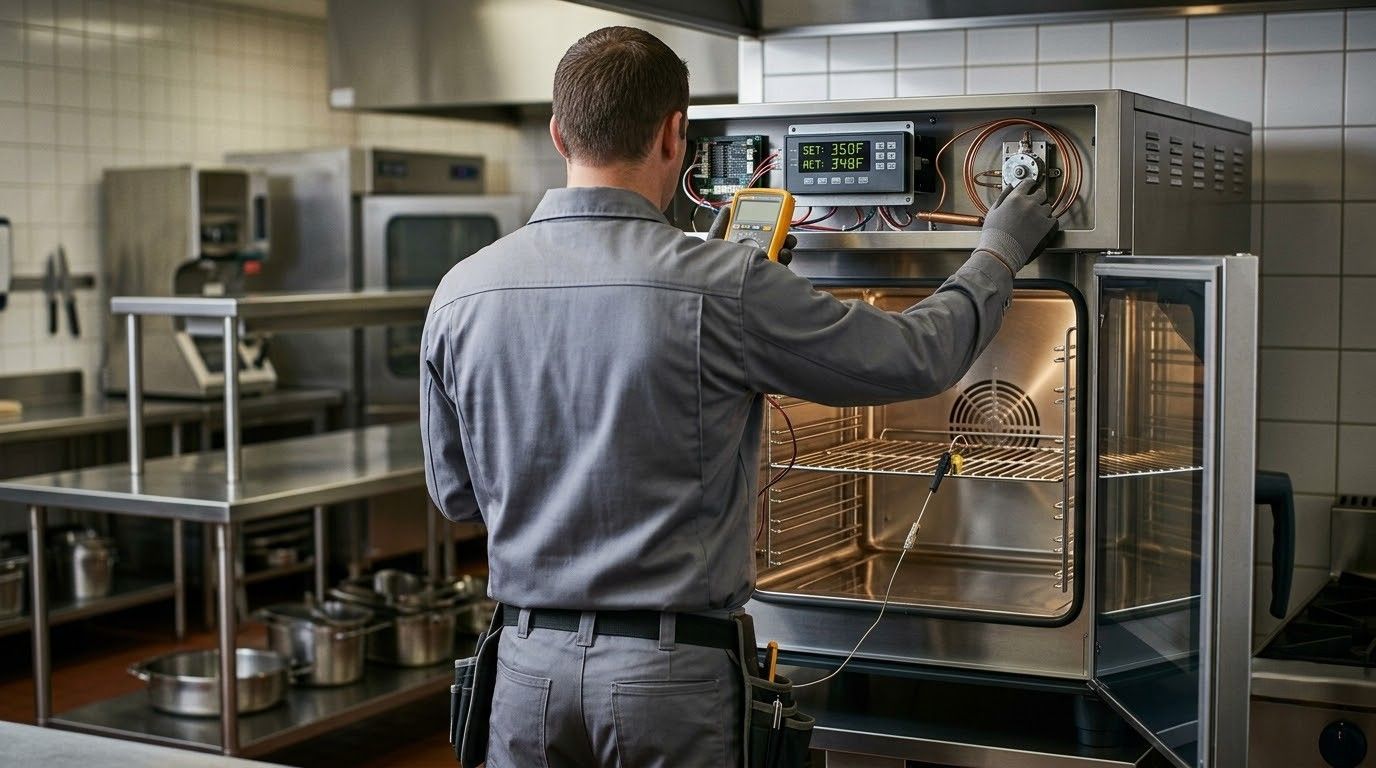
CALIBRATION
Thermostat and Control Calibration
Snap-action and modulating thermostats, capillary bulbs, and digital controllers. The correction is made against a measured cavity reading and then re-verified after a full cycle, not assumed from the adjustment screw.
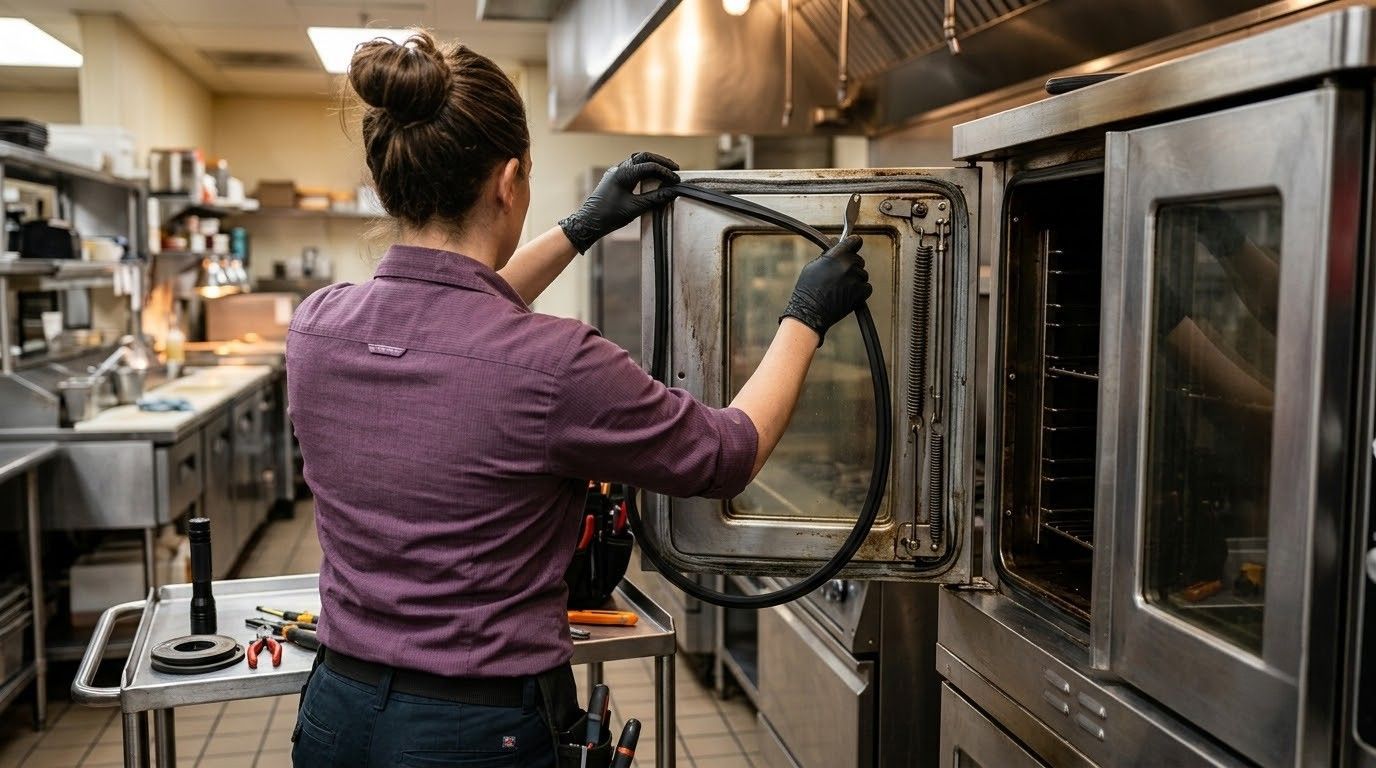
SEALS AND DOORS
Door, Gasket, and Hinge Repair
Compressed gaskets, sagging hinges, broken springs, and latches that no longer pull the door tight. A door that closes but does not seal loses heat continuously and shows up as uneven product.
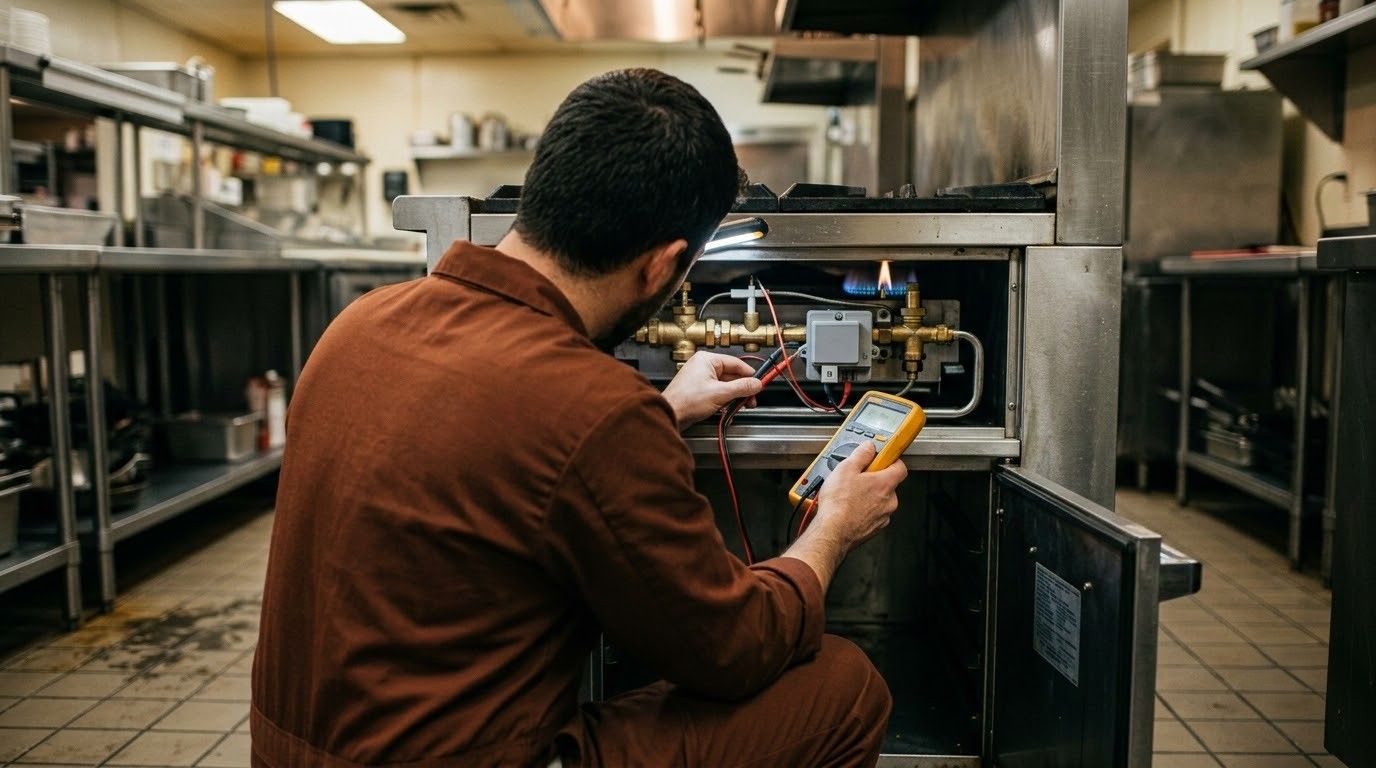
IGNITION
Ignition, Pilot, and Valve Service
Standing pilots, spark modules, flame sensors, and gas valves. The ignition sequence is read step by step with a meter, so the failed component is identified rather than inferred from a symptom.
faq
frequently asked
questions.
Oven and range questions we answer most weeks, drawn from what kitchen staff actually ask once the panel is off and the readings are sitting on the table in front of us.
What is the most common oven problem?
Temperature that no longer matches the setting. Thermostats drift as bulbs lose charge and contacts wear, and the fault usually appears at the low end of the range before anyone notices it at high heat.
Why does my oven not heat evenly?
Airflow, sealing, and burner distribution are the three causes. A slowing convection motor, a gasket that no longer seals at the hinge, or a partly blocked flue will each produce hot and cold zones.
Is it normal for an oven to be off by 50 degrees?
No. A commercial oven should hold within a few degrees of setpoint once stable. A 50-degree gap means the thermostat needs calibration or replacement, and it is almost certainly costing you product already.
How do you calibrate a commercial oven thermostat?
A calibrated probe is placed in the cavity, the oven is cycled until the temperature stabilizes, the difference between actual and indicated is recorded, and the thermostat is adjusted and then re-tested through a full cycle.
Why is my burner sparking but not lighting?
Spark proves the igniter works, not that gas arrived. Look at the gas valve, the flame sensor circuit, and manifold pressure. A blocked port or a low supply pressure will spark all day without catching.
Why does the fan in my convection oven not work?
Usually a seized motor, a failed capacitor, or a door switch cutting the circuit when the door closes. Elite Flame Appliance Repair LLC tests all three in order on convection calls across La Puente, CA.
Does a commercial convection oven need a hood?
Usually yes. Type I or Type II hood requirements depend on the appliance and what it produces, and local plan check makes that call. Elite Flame Appliance Repair LLC helps operators across La Puente, CA sort that out.
Why does my oven take so long to preheat now?
Preheat time lengthens when burner output drops or heat escapes faster than it is produced. Check manifold pressure, port condition, and the door seal. A partly blocked flue will also slow recovery noticeably.
HOW WE WORK
FROM A DRIFTING DIAL TO A VERIFIED CAVITY.
STEP 01
Take The Symptom Down
Tell us whether product is browning unevenly, cook times have grown, or the unit will not light at all. Each of those points at a different subsystem and changes what rides on the truck.
STEP 02
Book The Quiet Hours
Bakery ovens get looked at in the afternoon and restaurant ovens between services. We set the visit where it interrupts the least, including weekends when that is what your own schedule genuinely requires.
STEP 03
Measure Before Touching Anything
A probe goes in the cavity and a manometer goes on the gas line before a single panel comes off. Those two numbers eliminate most of the possible causes within the first 10 minutes.
STEP 04
Show You What We Found
You see the actual reading against the setting, and the parts that are worn. Nothing gets replaced on the strength of a guess, and nothing gets replaced without you knowing exactly why first.
STEP 05
Correct And Re-Verify
The repair or calibration is made, then the oven runs a complete cycle and gets measured again at temperature. A calibration that was never re-tested afterward is a calibration that nobody should be trusting.
STEP 06
Hand Over The Numbers
Before and after readings, manifold pressure, and parts replaced go on the paperwork. Keep it with the unit, because the next technician who opens that panel will be much faster for having it.
REQUEST YOUR SERVICE CALL
STOP PAYING FOR AN OVEN THAT GUESSES.
A drifting thermostat charges you in wasted product long before it shows up as a repair. Send the make, model, and symptom through the contact form or the booking page, and we will get a probe in that cavity.
WHAT YOUR SERVICE CALL COVERS:
- Cavity temperature mapped with a test probe
- Manifold pressure read at the appliance
- Ignition circuit tested step by step
- Door seal, hinge, and gasket inspection
- Calibration re-verified through a full cycle
- Before and after readings in writing