

Commercial Refrigeration Repair
COMMERCIAL REFRIGERATION REPAIR IN La Puente, CA.
Cold holding in California is 41 degrees or below, and Los Angeles County records a major 4-point violation when potentially hazardous food is found between 50 and 130 degrees with nobody intervening. Elite Flame Appliance Repair LLC provides commercial refrigeration repair in La Puente, CA for walk-in coolers and freezers, reach-ins, prep tables, and display cases, covering defrost faults, iced evaporators, condenser cleaning, controls, and certified refrigerant recovery on every sealed system call. Nothing gets charged before the leak is found.


A WALK-IN DOES NOT FAIL ALL AT ONCE.
It drifts. Two degrees this month, four the next, and by the time somebody notices the milk, the compressor has been running nearly nonstop for weeks. That is why we look at run time and coil condition rather than just the box temperature, because the box temperature is the last thing to go wrong.
Cooling capacity is tested against what the box has to do, not against what a gauge says at idle. Product load, door traffic, and ambient kitchen heat all belong in that calculation.
- Condenser and evaporator coils inspected and cleaned
- Defrost cycle timing and termination verified
- Leaks located before any refrigerant is added
- Box temperature logged against product load
COMMERCIAL REFRIGERATION REPAIR
ICE ON A COIL IS A SYMPTOM OF SOMETHING ELSE.
An evaporator packed with frost is almost never a refrigerant problem. It is a defrost timer that has stopped advancing, a termination sensor that never calls the cycle off, a heater element gone open, or a door gasket letting humid kitchen air in all day. Chipping the ice off restores cooling for about a week and teaches you nothing about which of the four it was.
SAN GABRIEL VALLEY HEAT PUNISHES CONDENSERS.
August highs in this part of Los Angeles County average near 89 degrees, and a kitchen condenser is usually breathing air well above that. High head pressure is the normal operating condition here, not the exception, which is why manufacturers specify condenser cleaning every 30 days and why neglected coils fail compressors faster in La Puente than the service manual ever assumes.
NOBODY CALLS US WHEN THE WALK-IN IS FINE.
Every refrigeration call arrives with product on the line and a clock already running, and that shapes how the work gets done. Stabilize first, diagnose second, repair third. Getting a box back down to a safe holding temperature while parts are on the way has saved more inventory over the years than any single component we have ever replaced. What is your box actually reading right now?
WHY CHOOSE US FOR COMMERCIAL REFRIGERATION REPAIR.
Product That Stays In Temperature
A box holding steady at 38 degrees is inventory you keep. The repair pays for itself the first time a delivery arrives and nothing has to be thrown out.
Leaks Found, Not Just Topped Up
Adding refrigerant without finding the leak is a subscription, not a repair. Federal rules require leak repair on larger systems, and we treat smaller ones the same way.
Defrost Faults Solved At The Cause
An iced coil gets traced to the timer, the termination control, the heater, or the door seal. Clearing the ice without finding which one just resets the clock.
Warranty Coverage Protected
Manufacturers void compressor claims traced to dirty condensers. Documented cleaning at the interval they specify is what keeps that argument from ever getting started in the first place.
Inspection Records That Hold Up
Temperature logs and service documentation matter when an inspector asks how a box fell out of range. Written findings after every visit give you something concrete to show.
Emergency Response That Actually Answers
Refrigeration does not fail politely at 10 a.m. on a Tuesday. 7-day availability means a failing box gets attention while the product inside it is still worth saving.
WHAT WE FIX
OUR REFRIGERATION WORK
Six areas cover almost every cold-side call, from a walk-in that will not pull down to a display case sweating on the sales floor. Each one has a different first test.
WALK-INS
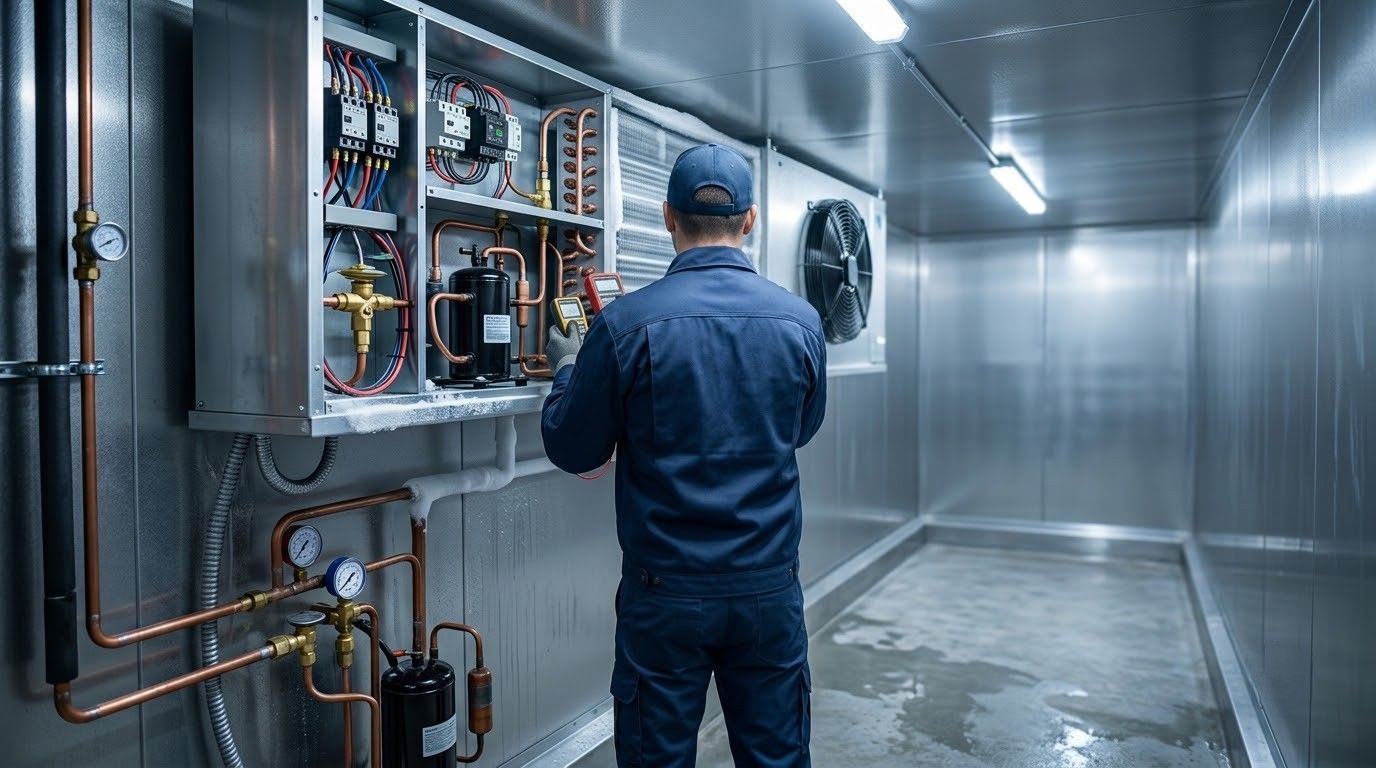
Walk-In Cooler and Freezer Repair
Compressors, condensing units, evaporator fans, expansion valves, and controls. Run time is measured against box temperature, because a unit running continuously and still holding 41 degrees is already failing quietly.
DEFROST
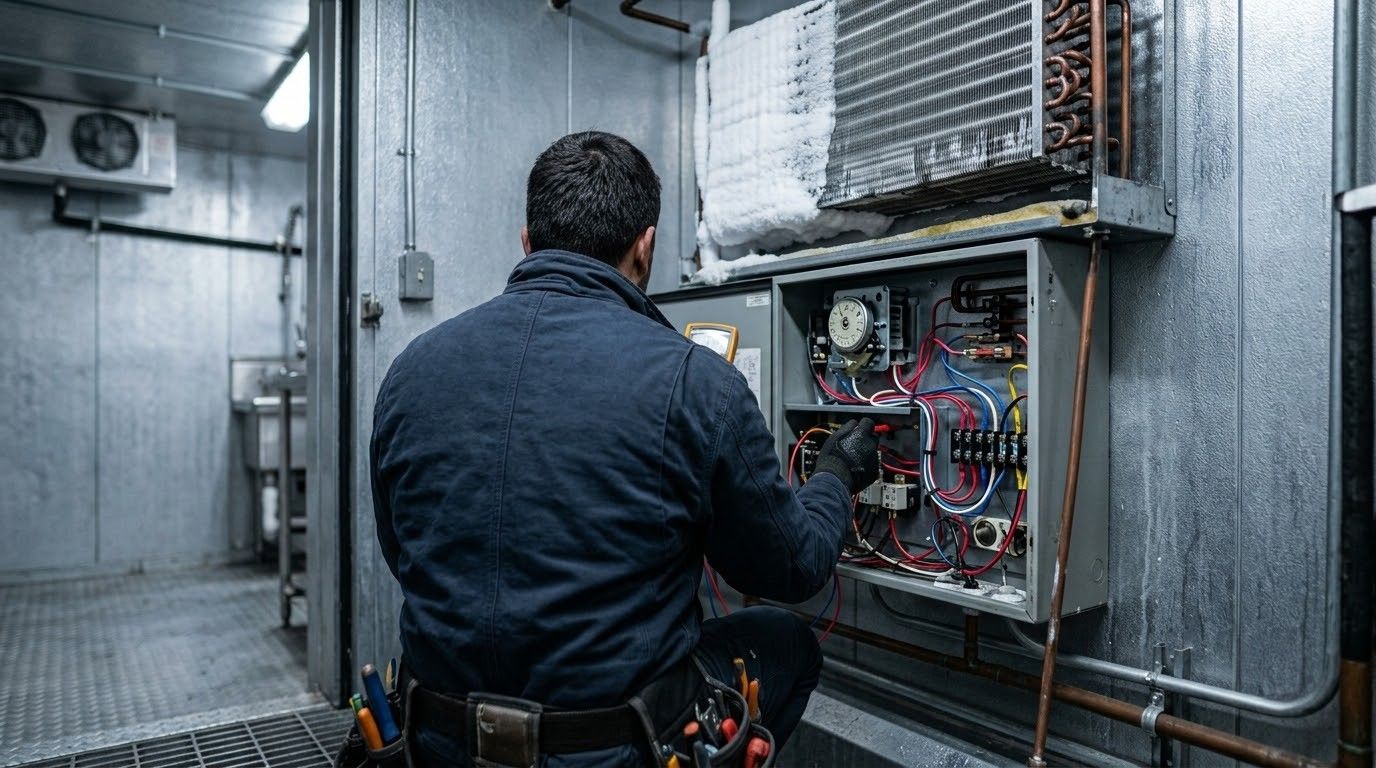
Defrost System Diagnosis
Timers, termination sensors, heater elements, and drain line heaters. A typical cooler defrosts several times in 24 hours, and a cycle that never terminates ices a coil solid within days.

REACH-INS
Reach-In and Prep Table Service
Door gaskets, hinges, thermostats, condenser fans, and drain pans. Prep tables suffer most from ambient kitchen heat, so clearance behind the unit gets checked as carefully as the sealed system.

SEALED SYSTEM
Leak Detection and Refrigerant Service
Electronic detection, soap testing, and pressure verification before anything is charged. Recovery is done to federal standards, never vented, and the repair is verified after the system has run at load.

COILS
Condenser and Evaporator Cleaning
Coils packed with grease and lint raise head pressure, cut capacity, and shorten compressor life. Cleaning is mechanical and chemical as needed, with fin combing where the fins have folded over.
DISPLAY CASES
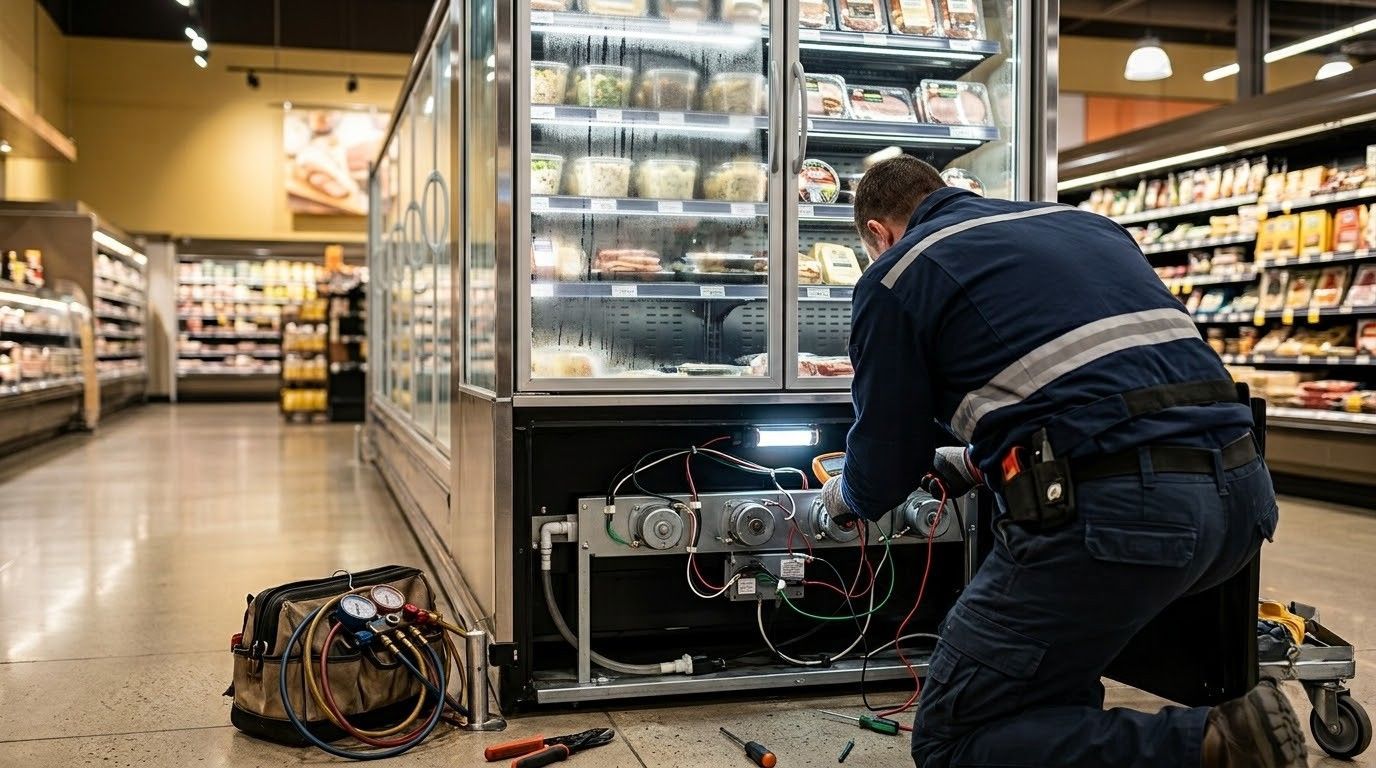
Display Case and Merchandiser Repair
Case fans, anti-sweat heaters, glass door seals, and lighting that adds heat load. Sweating glass and warm product at the front usually trace back to airflow rather than to the compressor.
faq
frequently asked
questions.
Refrigeration questions we hear constantly, mostly about ice where it should not be, boxes that will not hold temperature, and how often a condenser really needs attention.
What are the most common problems with walk-in coolers?
Iced evaporator coils, failed door gaskets, dirty condensers, and defrost controls that stop cycling. Three of those four are maintenance issues rather than component failures, which is why service intervals matter so much.
Why does my walk-in freezer's evaporator coil keep freezing up?
The defrost cycle is not completing. Look at the timer, the termination thermostat, and the heater element. A door left open or a torn gasket will also load the coil with moisture faster than defrost can clear it.
What is the correct temperature for a commercial refrigerator?
At or below 41 degrees for potentially hazardous food under California rules. Most manufacturers set reach-ins near 35 degrees from the factory to leave headroom for door openings and warm product going in.
My walk-in compressor is not running. What could be causing it?
A tripped overload, a failed start component, a contactor not pulling in, or a control calling for nothing because the thermostat has failed closed. Elite Flame Appliance Repair LLC works through those in order across La Puente, CA.
How often should commercial refrigeration be serviced?
Condensers need cleaning roughly every 30 days in a kitchen environment, and a full system inspection twice a year is reasonable. Grease-heavy operations will need the coils looked at considerably more often than that.
Is refrigerated food safe at 45 degrees?
Only in narrow cases. California allows serving lines and salad bars above 41 but not above 45, for no more than 12 hours in any 24, with unused portions discarded afterward.
Why is my cooler running constantly but not getting cold?
Usually a dirty condenser, a low charge from a leak, or an evaporator fan that has stopped moving air. Elite Flame Appliance Repair LLC checks all three before touching gauges on jobs in La Puente, CA.
How quickly does refrigeration have to cool hot food?
California requires 135 down to 70 degrees within 2 hours, then 70 to 41 within another 4, so 6 hours in total. A box that cannot manage that curve is an equipment problem.
HOW WE WORK
FROM A WARM BOX TO A STABLE HOLDING TEMPERATURE.
STEP 01
Get The Reading First
Tell us what the box is showing, what it should show, and whether the compressor is running. Those three answers narrow a refrigeration fault more than any other information you can give us.
STEP 02
Protect The Product
If the box is climbing, we will tell you on the phone what to move and what to keep shut. Losing inventory while waiting for a technician is avoidable more often than people expect.
STEP 03
Inspect Before Gauging
Coils, fans, gaskets, drain lines, and defrost function get checked before any gauge goes on the system. Most refrigeration faults are found there, and connecting gauges unnecessarily risks losing charge you already paid for.
STEP 04
Find The Leak Before The Charge
If the system is low, the leak gets located and repaired first. Charging a leaking system puts refrigerant into the atmosphere and puts you back on the phone within a month or two.
STEP 05
Run It Down And Watch It
The box is brought back to temperature and observed through at least one full cycle, including a defrost where relevant. A cooler that reads correctly for 10 minutes has proven nothing at all.
STEP 06
Log It For The Inspector
Temperatures, pressures, coil condition, and the work performed are written down. That paperwork answers a health inspector's question and it supports a warranty claim if the compressor eventually gives out on you later.
REQUEST YOUR SERVICE CALL
GET THE BOX BACK BELOW 41 DEGREES.
Every hour a cooler runs warm is inventory and inspection risk at the same time. Send the box temperature, the make, and what the compressor is doing through the contact form or the booking page.
WHAT YOUR SERVICE CALL COVERS:
- Box temperature verified against product load
- Condenser and evaporator coils inspected
- Defrost cycle timing and termination tested
- Leak detection before any refrigerant is added
- Refrigerant recovered to federal standards
- Written temperature and pressure log